Questions About Products and Certifications
General Information
Vehicle Classification:
M1: A passenger vehicle with 8 or fewer seats in addition to the driver's seat.
M2: A passenger vehicle with more than eight seats in addition to the driver's seat, and with a maximum weight not exceeding 5 tons.
M3: A passenger vehicle with more than eight seats in addition to the driver's seat, and with a gross vehicle weight exceeding 5 tons.
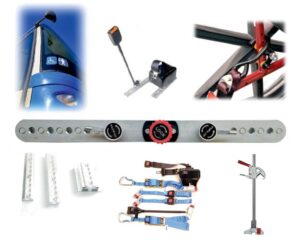
Wheelchair and occupant restraints:
-Unless otherwise specified, these restraints must always be used with the passenger and wheelchair facing forward.
-The combined weight of the wheelchair and passenger must never exceed the maximum weight for which each restraint has been tested.
-As a general rule, the wheelchair user must have a space of 1300 mm x 750 mm, allowing for 650 mm of clearance from the front of the wheelchair occupant’s head and 400 mm from the back.
-In cases where it is not mandatory, it is recommended to use a seat belt for the passenger in addition to the wheelchair restraint.
-For safety reasons, if you notice any damage to the wheelchair restraint system or the occupant’s seat belt due to use, replace it with one in good condition.
-It is recommended that the person responsible for handling the safety equipment be familiar with its use, both for installation and in case of an emergency.
Guides:
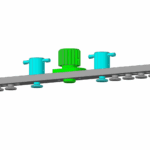
-For optimal performance, ensure that the pair of guides is perfectly aligned.
-When used in conjunction with chair bases, in addition to the above, the guides must be exactly parallel, and the holes in the guide grooves must be aligned on the same perpendicular line.
The distance between the two guides must coincide exactly with the centers of the holes in both seat legs.
-Regular cleaning of the guide grooves is recommended for proper operation.
-Ensure that the guide has been installed in the vehicle according to the specific requirements for each vehicle type and its intended use.
-We recommend that the installation of the guides in the vehicle be performed by qualified personnel, in accordance with the specific instructions and standards.
Seat bases:
- They must first be attached to the chair legs and then positioned precisely in the center of the guides.
- Make sure that all the holes in the chair leg have been used when attaching the base.
Consulting:
Técnicas Aplicadas de Movilidad, S.L. is able to provide consulting services regarding the use and installation of each of our products, as well as guide customers toward the ideal solution for their specific needs.
Manufacturing:
Thanks to close collaboration with our various suppliers, Técnicas Aplicadas de Movilidad, S.L. is able to offer our customers the opportunity to design and manufacture products specifically tailored to their needs.
General:
No product supplied by Técnicas Aplicadas de Movilidad, S.L. may be modified under any circumstances, as this would compromise the product’s safety and void the warranty. Técnicas Aplicadas de Movilidad, S.L. shall not be liable for any consequences arising from any modifications.
Due to the ongoing development of our products, Técnicas Aplicadas de Movilidad, S.L. reserves the right to change the product design without prior notice.
References Relevant
Associations and useful links:
Relevant Regulations:
- ISO 10542-1 (English) – LINK
- UNE 26494 – LINK
- DIRECTIVE 2001/85/EC OF THE EUROPEAN PARLIAMENT AND OF THE COUNCIL (Special provisions applicable to vehicles used for the carriage of passengers with more than eight seats in addition to the driver’s seat (M2 and M3)) – LINK.
Technical bodies authorized in the field of type approval:
- APPLUS + IDIADA – website: www.applusidiada.com
- INSIA – website: www.insia-upm.es
Leading institutions:
- CERMI (Spanish Committee of Representatives of People with Disabilities) – website: www.cermi.es
- ASPACE (Spanish Confederation of Associations for the Care of People with Cerebral Palsy) – website: www.aspace.org
- DISCAPNET: The Portal for People with Disabilities – website: www.discapnet.es
- European Disability Forum /Transport. (Foro Europeo de la discapacidad) (Inglés) – LINK
- Derechos del pasajero con movilidad reducida en el transporte en autobús y autocar: (Inglés) – LINK
Type your paragraph here